

When a milestone depends on another team's date, a slip over there shows up here - on your timeline, the day it happens. The link is recorded once and does the watching for you.
Project and portfolio memory
The dates moved. Nobody wrote down why.
Every organization keeps its plans - in spreadsheets, slide decks, and a project tool nobody updates. Almost none of them keep the reasoning: why a date moved, which risk caused it, who decided. Theruka keeps both, so strategic work stops disappearing into meetings, files, and chat history.
No card, nothing to install. Start with the spreadsheet you already have.
- PastLearn from what happened
- DecisionChoose the right path at the right time
- FuturePlan with clarity and confidence
Decision memory
A plan tells you what you agreed to. It rarely tells you why it changed.
Six months in, the dates are different, three assumptions have quietly moved, and the file that explains any of it was never written. So the same question gets re-argued every quarter, and a slipped date looks exactly like a bad decision.
Decision memory is the missing half: the record of why the plan is what it is, kept next to the plan itself. It turns "this is late" into "this is late because we chose the pilot over the full rollout in March, and here is what we did about it."
- Why, not just what Every change carries the reason it happened, next to the change itself.
- Settled stays settled The argument you finished in March does not come back in June.
- A slip has a cause You can tell a date that moved for a reason from a decision that went wrong.
Blockers
Most things are not late because the work is hard.
They are late because a decision sat unmade for eleven days, because the team waiting was never told the date they depend on had moved, or because nobody could say which of forty open items actually mattered this week. None of that is a delivery problem. It is a memory problem.
Not forty open items. The handful that are actually urgent this week: a risk nobody has answered, a date nobody has confirmed, a milestone drifting quietly. Ranked, with the reason each one is on the list.
A risk with no owner is how something waits three weeks for nobody. Anything recorded here carries the person answerable for it, and how long it has been sitting.
When the same kind of problem has come up before, the record shows what was tried and whether it held - adding people, or moving the date early, and which of the two actually stuck. That is your own history, not a benchmark from somebody else's company.
The cost of doing nothing
Nobody budgets for this, and everybody pays it.
Nobody recorded why the scope changed in March, so the question comes back in June, and again in September - with the same people and less patience.
A slip becomes visible at the steering meeting, weeks after the first signal was already sitting in someone's spreadsheet.
Every reporting cycle, someone assembles the same picture by hand from the same scattered files, and it is stale the moment it is sent.
By the second month, "why is this late?" is a ten-second answer instead of a two-day search through files and chat history - and the answer is the same one everybody sees.
Do the sum with your own numbers.
- Half a day, every week, for one person rebuilding the same status from the same scattered files. Twenty-six days a year, before anybody reads it.
- An hour of a steering meeting spent re-establishing what was already decided, times the number of people in the room, times however often you meet.
- And the expensive one, which nobody puts in a spreadsheet: the week a dependency slipped and the team waiting on it carried on regardless, because nobody told them.
Whatever a seat here costs - the plans are on the sign-up page - the first number on that list is larger. And that first number is the one you are already paying, every week, without it ever appearing on a budget line.
How it works
Three things a plan should never lose.
The reasoning behind a change lives with the plan itself - not in an inbox, a chat thread, or a meeting nobody minuted.
When a date moves, the record shows what caused it - so a slip you understood is never mistaken for one you did not see coming.
The executive view exists without anyone assembling it. No one spends Thursday rebuilding a status deck for Friday.
What's inside
The work around a plan, done in the same place.
One page a week: what needs talking about, project by project. Owners write their line from a phone, the decision is kept next to the item, and the weekly report is ready to print - with Trends across the last eight weeks.
Next to each committed date, the date it is likely to finish - learned from how this team's own milestones have finished before, not from optimism.
The milestones that moved most, and each one's story: every move, who made it and why, the reason that keeps coming back, and which moves only followed something it waits on.
Bring the plan you have - Excel, MS Project, Word, PowerPoint or PDF - and it is read into milestones, owners and dates. theruKO, the assistant, drafts the weekly update and turns one sentence into a complete change.
One version of the truth
The plan, the report and the answer are three copies of the same thing.
That is where the friction comes from. The plan lives in one tool, the report is rebuilt by hand in another, and the answer to "why did this move?" is reconstructed from memory in the meeting itself. Three artefacts, maintained separately, disagreeing quietly - and the executive is the one who finds out they disagree.
The plan
Kept onceDates, owners, dependencies and risks in one place - imported from the plan file you already have, or pulled from Jira or Monday with the history of every date, so it stays in step with where the work actually happens.
The report
Not rebuilt - readThe executive view is the plan, arranged for somebody who has ten minutes: what moved, what caused it, what is still unanswered and how long it has been open. Nobody assembles it, so it cannot be out of date or quietly flattering.
The question
Answered from the same record"Why is this three weeks later than March?" is answered by the plan itself, in front of everybody, with the risk that moved it and what was decided. Not from a memory that flatters whoever is speaking.
When those three stop being separate documents, the arguments they used to cause stop happening. The meeting is about what to do next, rather than about whose version of last quarter is right.
How it works
This is your plan, minutes after you upload it.
Bring the spreadsheet your team already argues over, or paste the plan as text. Theruka reads the milestones, dates, owners and risks out of it and builds the executive view for you - then keeps the reason attached to everything that changes afterwards.
Start your free trial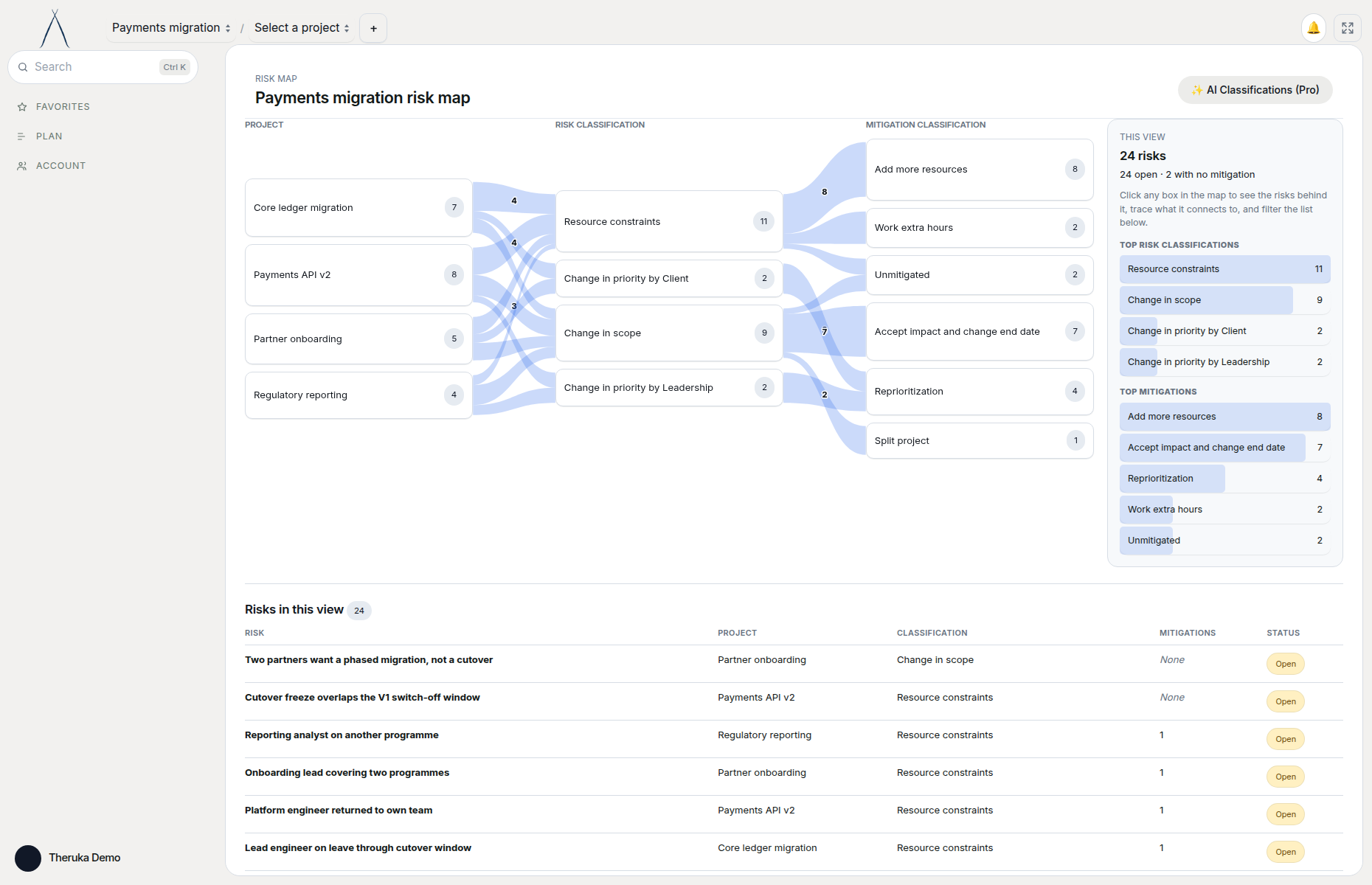
Where it fits
It works with the plans you already have.
You do not migrate anything or ask anyone's permission to start. Upload one plan, keep using the spreadsheet next to it if you want, and see whether the second month is calmer than the first.
- Your files, not a new formatExcel, CSV, MS Project, Word, PowerPoint, PDF or pasted text in - reports out as PDF
- Your data stays yoursNothing is shared until you share it, and there is no lock-in
Before you try it
The three questions everyone asks first.
- Do I have to give up my spreadsheet, or Jira, or MS Project?
- No. Theruka sits above whatever you already run rather than replacing it - your team keeps working where they work. Bring a plan in from Excel, CSV, MS Project (saved as XML), Word, PowerPoint, PDF or pasted text, or connect Jira or Monday: the work comes in with the history of every date, and stays in step when you pull. The connection only reads - Theruka never writes back to Jira or Monday.
- Who else has to approve this before I can try it?
- Nobody. Free is two people, one portfolio and one project, sign in with Google - no card, no install, nothing for IT to deploy. You can load your own plan this afternoon and decide on your own evidence. Bring the PMO in later, once you have something worth showing them.
- Where does my data live, and can I get it back out?
- In your own workspace, private by default: nothing is visible to anyone else until you deliberately share it, and every share is a link you control and can revoke. Reports print to PDF from inside the product, and if you ever want a full copy of your data, ask us and we will send it. Enterprise adds a security review for organizations that need one before they can say yes.
- Your data stays in your workspace
- No sharing without your permission
- Your data back whenever you ask - no lock-in
Company